Maternal Health Anxiety: Why do I panic every time my child gets sick?
If a symptom like a fever instantly triggers worst-case thoughts, compulsive checking and googling, and an intense physical reaction, you may be experiencing health anxiety — and yes, it can cloud your intuition. Your child’s “spidey senses” pick up on your body vibrating in panic as well.
It isn’t something you can “logic” your way out of, or simply stop because someone asks you to. Nor are you a helicopter mum who just needs to relax. This is an automatic nervous system response running on a subconscious level. And that’s exactly what we need to address. So you can respond to what’s actually happening — instead of your mind running off into scary “what if” stories. And finally tell the difference between your real mum instinct… and anxiety spiraling.
Please keep reading to find out how your Ally can help (especially if talk therapy or CBT didn't work).
In a Nutshell: why every cough feels like a crisis
It’s not a "Logic" Problem: Health anxiety is a survival response triggered by your nervous system, not a lack of parenting skills.
The Mirror Effect: Your child’s nervous system co-regulates with yours; when you feel safe, they physically feel safer too.
The Cyberchondria Loop: Modern algorithms feed maternal fear, turning "checking" into a physical addiction that exhausts the brain.
Resolution is Possible: By retraining the subconscious "smoke alarm" via hypnotherapy, you can move from constant dread back to intuitive presence.
Targeting the root cause, so you can stop managing symptoms and start enjoying motherhood.
Is this normal new mum worry or is it actual maternal health anxiety?
Simple fever becomes Meningitis
“Wasn’t there an outbreak reported on the news…? What if that’s it?”
Tummy bug becomes Appendicitis
"Why does he keep touching his right side? We might need an ambulance."
A Bruises becomes Leukemia
“She’s bruising so easily… has she always looked this pale?”
A scratch becomes Sepsis (Blood Poisoning)
“What if it got infected? What if we miss the signs?”
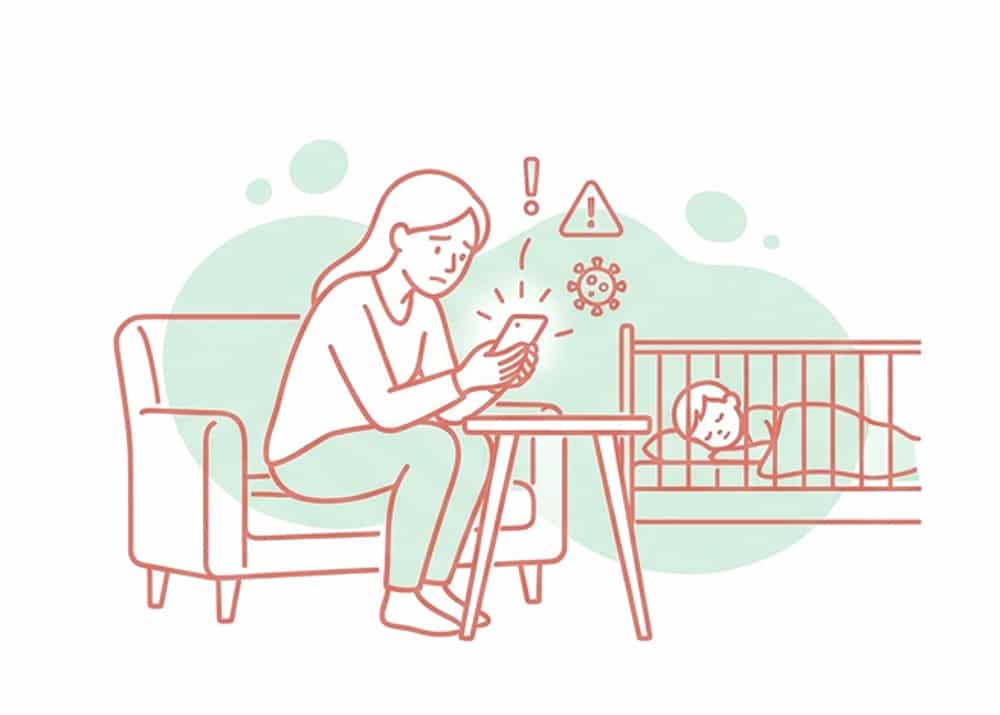
And you’re left hovering. Checking. Rechecking. Listening to your toddlers breathing 20 times a night and Googling until 3 a.m.
If this is what's making your life hard right now, I want you to hear this:
You’re not losing it. You’re not a bad parent. You’re not being dramatic on purpose. You’re not a “controlling helicopter mum.” This isn’t just first-time parent nerves. And it's not your fault. But it is your choice to free yourself from feeling like this.
"I feel like my anxiety is the only thing keeping them safe. If I stop worrying, will I miss something until it's too late?" That itself is part of the anxiety loop, and not helpful.
What is Maternal Health Anxiety?
Maternal health anxiety (often referred to as Health Anxiety by Proxy) is an obsessive preoccupation with a child’s health. Research suggests that up to 10% of new mothers experience significant health-related anxiety that logic alone cannot resolve.
Why can't I stop obsessing over my child's health symptoms?
You might ask yourself: “Why can’t I just keep an eye on it like a normal person?”
The short answer is: your internal alarm is miscalibrated. Think of it like a smoke alarm that goes off for slightly burnt toast. It’s meant to keep you safe, but right now it’s reacting as if the whole house is on fire when your child has a mild symptom.
So when your child shows a symptom, your nervous system reacts like it’s a full‑blown emergency, not “something to keep an eye on on”. Your heart races, your stomach drops, your chest tightens – and once your body hits emergency mode, logic can’t compete.
That’s why you find yourself checking, re‑checking and spiralling, even when another part of you knows it’s “probably fine”.
What happens in your brain and body when your child gets sick?
Trigger (symptom)
Your child coughs, spikes a fever or says ‘my tummy hurts’ – your brain’s threat centre (the amygdala) lights up and your body releases stress hormones like cortisol and adrenaline.
Alarm (nervous system)
Your autonomic nervous system flips into ‘fight, flight or freeze’: heart racing, tight chest, knot in your stomach. This is the same system that controls heartbeat and breathing – it doesn’t respond well to logic.
Loop (checking and Googling)
To try to feel safer, you start checking, Googling, seeking reassurance. Research on cyberchondria shows this often makes people feel more anxious after searching, not less.
This is an automatic nervous‑system loop, not a character flaw or a lack of logic. Once we calm the alarm at the body level, your thoughts start to quiet down too.
I know Googling my child's symptoms makes it worse, so why can't I stop?
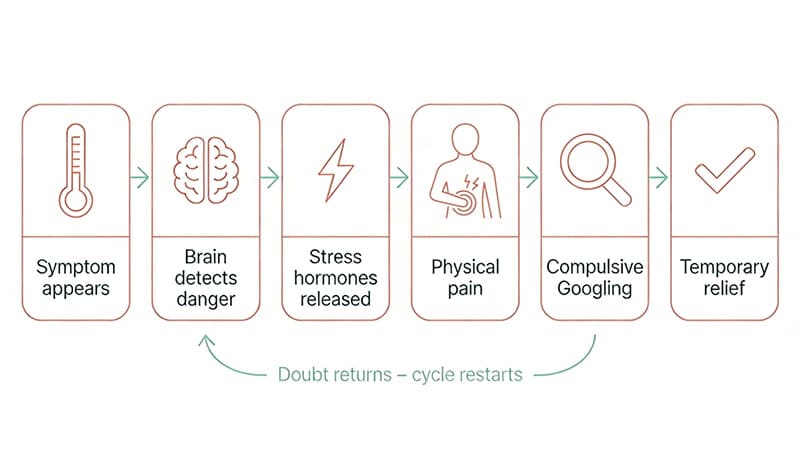
It usually goes like this:
- Your child gets a symptom
- Your body slams into alarm (nausea, racing heart, tight chest, that sick drop in your stomach)
- You check, Google, monitor, or seek reassurance
- You get a tiny hit of relief
- Then doubt creeps back — so you check again
Googling is like opening a trapdoor. You already know it makes things worse.
But in the moment it feels like the only way to feel safe and in control. It's your nervous system trying to regulate itself.
Searching Triggers New Worries
You're caught in a Cyberchondria loop. Studies show that 70% of people feel more anxious after Googling symptoms, not less."
How do I tell the difference between my maternal instincts and anxiety?
Is my intuition actually broken?
That's tricky — because anxiety is so loud and intrusive, it can feel like you're "ignoring your intuition" if you don't act on it. But intuition doesn't live in panic. It lives in presence. It's more like a quiet, confident whisper — not an alarm siren.
When the anxiety alarm is blaring, everything feels urgent and significant. Your body is too loud and busy for your real mum instincts to come through.
"Mom Gut" (Intuition)
- Feels like a quiet, neutral "knowing"
- Lives in the present moment
- Allows for logical action
- Comes from a place of "Presence"
Health Anxiety (The Siren)
- Feels loud, urgent, and intrusive
- Fast-forwards to "What If" futures
- Triggers heart racing and nausea
- Comes from a place of "Panic"
Why did I become so anxious after I became a mother?
"I never used to be like this."
Many women notice anxiety starting or intensifying after becoming a mother because motherhood itself flips a powerful biological switch sometimes called matrescence. During this time, the brain’s threat‑detection systems become hyper‑responsive to help you protect your baby.
Suddenly it’s not just your own body you’re scanning – it’s theirs too. And we live in a world that constantly spotlights rare, frightening stories.
"I saw one TikTok about a 'rare symptom' and now my feed is nothing but childhood cancer and medical tragedies. I can't stop scrolling even though it's making me sick."
The algorithm knows fear keeps you scrolling. So the more you click, the more it feeds you. Over time, your nervous system learns: Symptom = danger. Even when nothing is wrong.
Sometimes it starts after a specific trigger:
- a scary story you couldn't unsee
- something that happened to a friend's child
- a past health scare (yours or theirs)
- sleep deprivation — your stress bucket getting so full that any trigger makes it spill over
- years of being trained to scan for danger (very common in doctors, nurses, and anyone in healthcare)
In maternal health anxiety, that protective switch simply gets stuck in the ON position.
How do I stop my maternal health anxiety from rubbing off on my children?
As if it isn't bad enough to be worried about your child's health… now you're scared that your fear itself might be harming them.
So you try to mask your inner panic with a calm voice. But kids feel the difference. They have spidey senses. Even if they don't logically understand what's happening, they can feel your body vibrating with fear. And that can be scary — for both of you.
You don’t have to be perfect. Worry is normal. Being human is normal. You’re not going to "ruin" or “damage” your child just because you feel anxious sometimes.
What makes the real difference is this:
Learning how to calm your own nervous system. Because children don’t just pick up anxiety — they also co-regulate with their mother. So when your body starts to feel safer, theirs does too.
So this isn’t about hiding your fear. It’s about learning how to gently come back to calm — and showing them how to do the same.
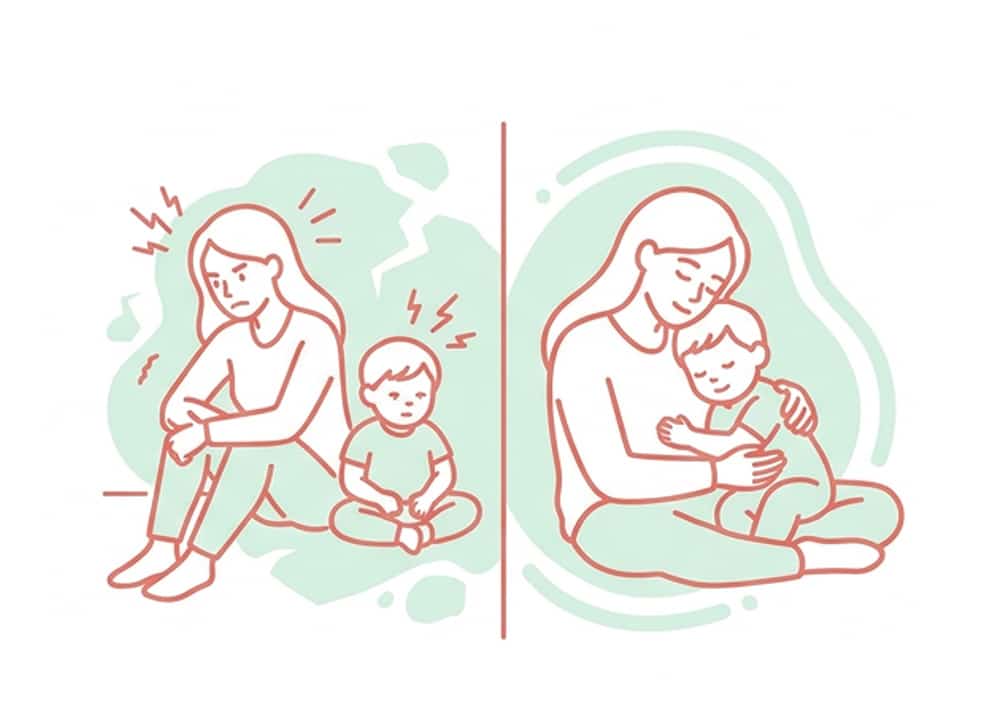
Your Stress Sets Their Stress
Research into Interpersonal Neurobiology shows that a child’s nervous system co-regulates with the parent’s. When your baseline cortisol (stress hormone) drops, your child’s nervous system physically feels safer.
Why CBT or Talk Therapy alone don't help with maternal health anxiety?
Here is what that means:
"My brain knows they're probably fine… but my body reacts like it's a car crash." That's because this isn't a thought problem. It's a nervous‑system response. This response sits in the subconscious — the same part of you that regulates heartbeat, blood flow, and breathing.
The alarm is there for a reason: to protect you and your loved ones. But when it's miscalibrated, it screams at steam and burnt toast — not just real fire. That's why therapies like CBT or talk therapy often don't go far enough. They don't reach the subconscious part of you that's driving the physical alarm.
| Feature | Talk Therapy / CBT | Hypnotherapy for Parents |
|---|---|---|
| Primary Focus | Logical thoughts & mindset | Subconscious & Nervous System |
| How it Works | Re-framing "what if" thoughts | De-activating the false 'Smoke Alarm' |
| Maternal Effort | High (Thought logs/homework) | Low (Deep relaxation/Rest) |
| Root Cause | Targets the cognitive symptom | Targets the physical survival loop |
| Timeframe | Long-term cognitive work | Rapid nervous system reset |
Why am I scared of germs and cancelling playdates over a runny nose?
Health anxiety about your child doesn't only show up when they're ill. It can spill into daily life — trying to prevent them from getting sick in the first place.
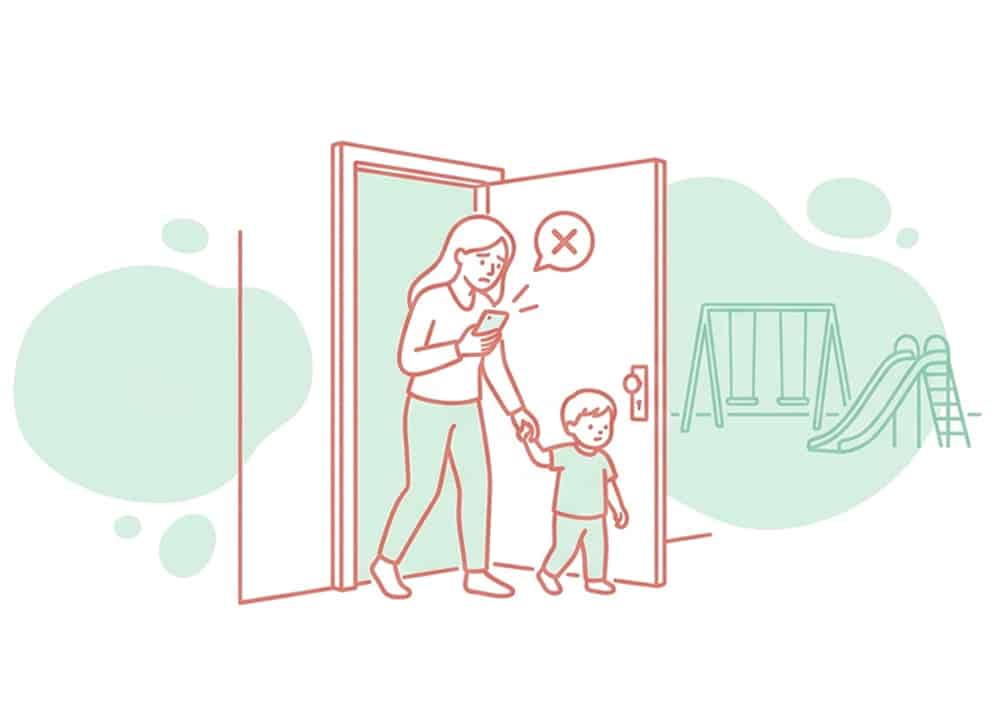
- avoiding playdates with kids who have a snotty nose or cough "just in case"
- dreading nursery, school, parties, indoor playgrounds, public places because they're full of germs
- flinching when someone coughs near them in the supermarket (or even getting angry)
- living in a smaller and smaller world where your own social life and pleasures barely exist anymore
And it can strain your relationship too.
Because when you're panicking, you're not "being stressed." You're genuinely in survival mode. Like being attacked by a bear in the forest. And just because the bear in this scenario is invisible doesn't mean it feels any less real. If your partner doesn't understand it, it can start to feel like:
- criticism ("You need to calm down.")
- frustration ("You're overreacting again.")
- minimising ("It's nothing.")
Meanwhile you're carrying the whole work load of sick‑kid mode: appointments, medicine, cooking, comforting, night‑watches. It's exhausting.
Meet Your Ally: Deirdriu Murray
Clinical Hypnotherapist
Deirdriu Murray provides specialised support for health anxiety and nervous system regulation for parents worldwide via Zoom, and locally in Fahan, Buncrana (Northwest of Ireland).

How Hypnotherapy can help mothers regulating their nervous system
Hypnotherapy for maternal health anxiety isn’t about “switching off” your protective instincts – it’s about helping you actually hear them again.
What we focus on
- Retraining your nervous‑system response so your concern is proportional, not catastrophic.
- Dialling down the false alarms so the real signals are easier to notice.
- Releasing old subconscious patterns and stories around illness, danger and responsibility.
The change we work towards
- you don't spiral every time
- your child gets a symptom
- you sleep better and feel more energized to handle whatever comes your way
the urge to constantly Google and check loses its grip - you feel calmer in your body (not just "holding it together")
- you trust yourself more — and can tell the difference between "needs attention" and "anxiety noise"
- your world widens again: germs feel manageable; normal life returns
Rewire your Nervous System
Hypnosis is an effective intervention for reducing anxiety, often outperforming traditional relaxation techniques because it addresses the subconscious autonomic nervous system.
Get the help you need: Move from physical pain to intuitive parenting
If you’re exhausted by the constant dread — the midnight Googling, the endless temperature checks, the fear that steals your sleep — let's talk.
You don't need another thing on your to-do list. You just need to lie down and let your nervous system rest and reset. You deserve to enjoy motherhood - not spend it terrified of losing you children.
*Gentle, medication-free anxiety relief. Safe for breastfeeding mothers.
Short Answers to Frequently Asked Questions
Why does it get so physically painful for me when my child gets sick?
Because stress hormones (like adrenaline and cortisol) can flip your body into fight/flight/freeze mode. That can cause a racing heart, tight chest, nausea, cramps, diarrhoea, and that knot-in-the-stomach feeling.
Is it health anxiety… or Motherhood OCD?
Maternal Health anxiety is the fear that your child has a serious illness — and it often comes with reassurance-seeking (checking, Googling, asking others).
Motherhood OCD can include health fears too, but it’s usually driven by intrusive thoughts plus compulsions/rituals you feel you must do to get short-term relief. (If you’re unsure, we can tease apart the pattern in your consultation.)
Can you help fathers and non-birthing parents as well?
It is for any parent. Fathers and non-birthing parents can get caught in the same panic-checking cycle of health anxiety.
Why matrescence can trigger postpartum health anxiety
Matrescence is a huge biological and identity shift that naturally increases protective vigilance. When you add sleep deprivation, stress load, scary stories online, or a real health scare, your system can learn: symptom = threat. That’s how normal protective worry can tip into constant scanning, spiralling, and worst-case thinking.
Is maternal health anxiety a permanent condition?
No. It’s a learned survival pattern, and learned patterns can be unlearned. The goal isn’t to “switch off” your protective instincts — it’s to turn down the false alarms, so you can respond clearly when something actually needs attention.
How much is the initial consultation and each follow up session?
The initial 30-minute consultation is £30 (€35 or $40). In the consultation, you’ll get a personalised quote. Follow-up sessions vary because they’re usually 60–120 minutes.
How many sessions will I need and can they be done online?
Most people need around 4–6 targeted sessions, and yes — sessions can be done online.
What do I need to get started working with my Ally?
Request your consultation and you’ll get a booking link where you can choose your time and date, and make your payment online. You can have your consultation via Zoom, Google Meet, WhatsApp video or phone.

The Ally Practioner Pledge
You are not imagining this, and there is nothing wrong with you. Together, we can work to restore your nervous system so it can finally respond proportionally again. This isn’t another 'to-do'—it is a deeply restorative experience designed to be easy, enjoyable, and relaxing.